Case Study: Stop Locking Inventory in Fixed Mounting Types
The ChallengeA motor supplier delivers motors pre-mounted in configurations like B35. At first, this seems efficient because the item arrives ready for use. But the problem appears later. Once the mounted motor is received as a fixed SKU, the stock becomes locked into one…
The Challenge
A motor supplier delivers motors pre-mounted in configurations like B35. At first, this seems efficient because the item arrives ready for use.
But the problem appears later.
Once the mounted motor is received as a fixed SKU, the stock becomes locked into one configuration. Even if the motor core can be reused with another flange or mounting type, the system only shows it as B35 stock.
This creates a gap between what is physically available and what the inventory system says is usable.
The Manual Problem
Before using a structured process, teams usually manage this in one of two ways.
They either create separate stock records for every mounted variant, which makes inventory complex, or they receive the item as one general motor and lose visibility of the flange or mounting component.
Both methods create planning issues.
Sales may think stock is unavailable. Purchasing may reorder motors unnecessarily. Warehouse teams may have usable components on hand but no clear way to reflect that in the system.
The Structured Workflow
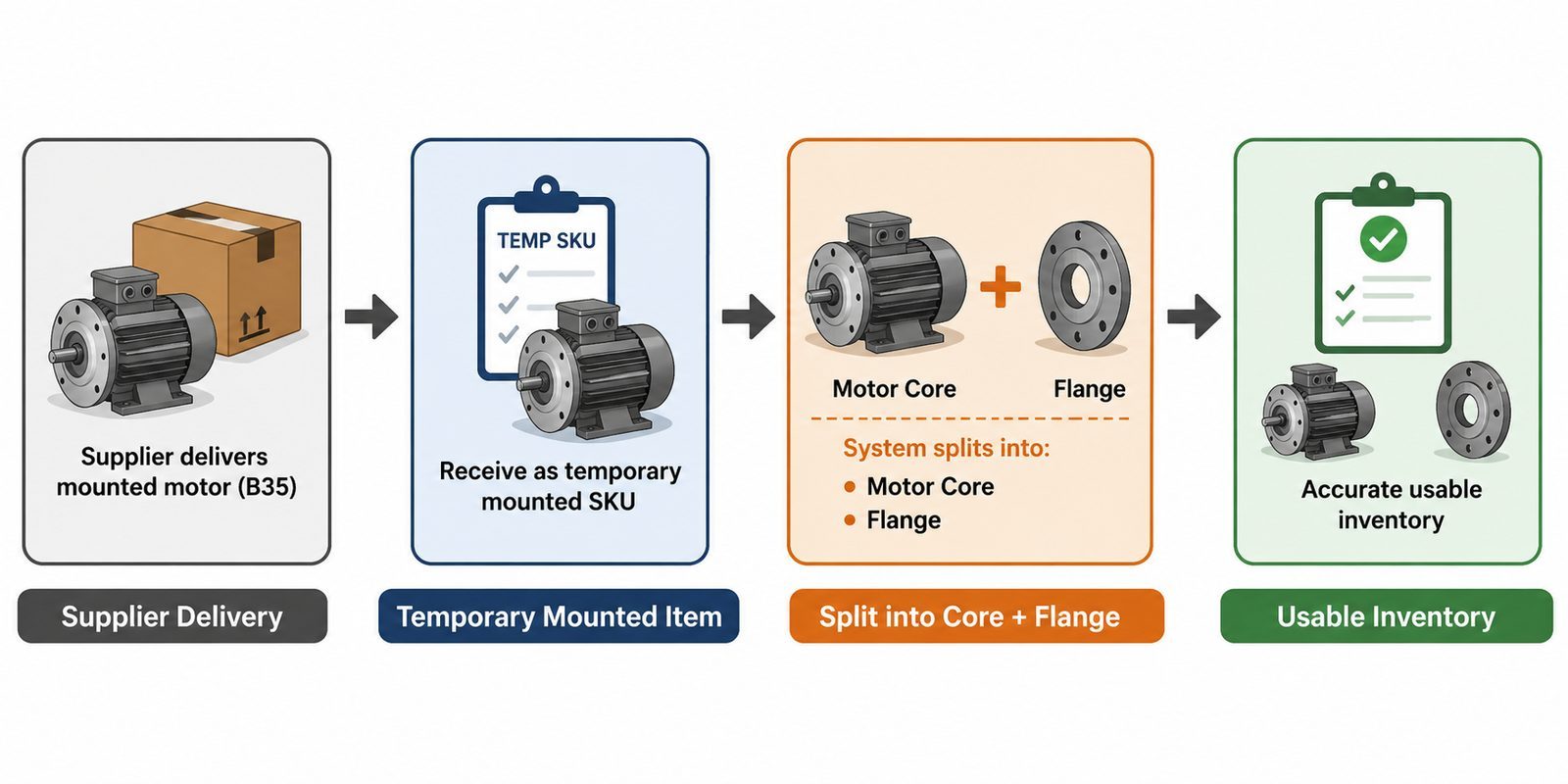
To solve this, the mounted motor is first received under a temporary SKU.
For example:
Received item: B35 mounted motor Temporary SKU: Mounted motor for receiving only
The temporary SKU is then split into its real inventory components:
Motor coreB35 flange
After the split, the temporary SKU is cleared from stock. This prevents duplicate inventory and ensures the system only shows the usable components.
The Result
The business now has a cleaner and more flexible inventory view.
Instead of locking stock into a supplier-delivered mounting type, the system shows the motor core and flange separately. Teams can plan based on what is truly available, not just the configuration that arrived from the supplier.
Business Outcome
This structured receiving process helps companies:
Reduce unnecessary purchasing Improve visibility of usable components Avoid duplicate or misleading stock records
Increase flexibility across motor configurations Improve planning accuracy
Conclusion
Mounted motors should not become permanently fixed stock just because they arrive that way.
By receiving them through a temporary SKU, splitting them into motor core and flange, and clearing the temporary stock, businesses can normalize inventory and unlock more flexible planning.
Stop treating mounted motors as fixed stock. Normalize stock. Unlock flexibility.